
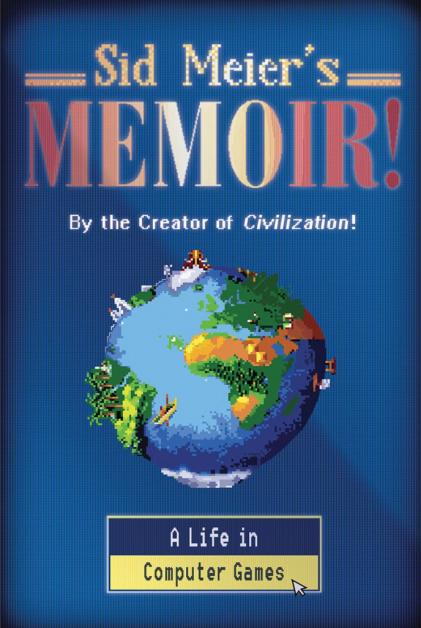
 Sid Meier’s Memoir!: A Life in Computer Games by Sid Meier, W. W. Norton & Company, October 12th, 2020
Around the time I picked up John Romero’s autobiography, I noticed Sid Meier’s also listed in the recommended section on Amazon. I didn’t pick it up initially because unlike with Romero and id Software, I had little experience with Sid Meier’s games though I certainly knew his name. I had played the 2004 remake of his Pirates! game and (I think), a little bit of Civilization III. Outside of these two games, I don’t think I’d played anything else he had designed and even the former, I did not play to completion until a few years ago. Still, he is undoubtedly one of the great designers in computer games and I eventually did pick this up about a year ago and finished reading it just the other day.
As I’ve reviewed quite a number of books based on gaming history, this was certainly worth adding to the growing list.
What was immediately refreshing in starting this book is that Meier jumps right into what the intended audience wants: games. There is certainly a biography here but the whole book is designed around what in many ways was his pioneering work in computer games. Each chapter begins by listing the game (or games) that will be covered though the chapters aren’t necessarily exclusive to the the listed games. In many cases, biographical anecdotes are shared in discussing these games such as his inspiration for 1990’s Railroad Tycoon being drawn from his childhood experiences observing the always punctual Swiss trains while briefly staying with family in his father’s homeland.
I was particularly interested to learn that many of his early games were flight simulators which I never previously associated with his name. Like many of his generation (including Richard Garriott), his early games were developed on his own and sold in bags before he co-founded MicroProse with Bill Stealey where his most recognised franchises including Civilization began. Bill is one of the more memorable and interesting real-life characters that appears in the book and the one most responsible next to Meier for the company’s success.
Throughout the book you also get some of Meier’s philosophy on game design such as this below on player choice which could also extend to player agency:
There are different theories as to why people instinctively flock toward more choices even when the numbers show we are happier with fewer choices, but I think it has to do with humans’ innate curiosity. We want to try everything, which leads to frustration when we can’t. We don’t ever want to feel like we’ve missed out on something good. In fact, there is a while class of so-called “completionist” players in videogames, who make it a point to collect every single items and score every single point possible. Most players are not that extreme, but even among moderate ones, the maxim holds. The more choices players have, the sooner they will tire of the game, and the more dissatisfied they will ultimately be. They might initially feel like they’re happier with more choice, but in the end they will walk away, just like the jam-asters with too many flavors to choose from. It was my job, I thought, to whittle down the options and present only the best ones to the player.
Keep in mind that Meier was designing games that were more complicated than average (even for the time), which makes it all the more interesting that he had this design philosophy. The above was from his discussion of the design of Sid Meier’s Pirates!
Another interesting quote is from his having to decide whether to make the original Civilization turn-based or real-time:
This was the eternal divide in the strategy genre: real-time versus turn-based. When the clock keep s running and everyone can play at once, there is an immediate increase in excitement. Quick thinking is rewarded over precision, and those with short attention spans finally get their day in the sun. But while the payoff is instant and ongoing, the ratcheting intensity can easily overflow into confusion and frustration. Turn-based gaming, on the other hand, is slow and methodical, and any excitement felt in the beginning is anticipatory at best. The comparative lack of intensity can risk sinking into boredom, but by the end, the payoff is usually bigger, because you’ve invested more time and personal choice into the outcome.
Real-time has largely won out today as is evident in games like the Final Fantasy VII Remake which I reviewed earlier this year. The turn-based gameplay in JRPGs is relatively simple compared to grand strategy and turn-based tactical games found on PC but many series are still moving that way regardless. There are also a number of attempts to mash turn-based and real-time that have usually been very awkward though some have worked out okay. Fallout Tactics: Brotherhood of Steel immediately comes to mind here. In the same section Meier also has readers imagine what a game of chess would be like if players could keep making moves. The game would immediately fall into chaos and additional rules would be required to have any hope of it working.
AI was something that outside of science-fiction, was almost exclusively discussed in video games until a few years ago. This has been something developers seem to have largely given up on though integrating LLMs has a lot of potential; depending on how it is executed. Meier shares a major problem with improved AI which simply comes down to player perception:
Even if we had taken the time to create more-nuanced algorithms, the truth is it wouldn’t have changed much. Highly realistic AI gets accused of cheating even more often than its dishonest brethren, because on some level, all players are unnerved by the idea that a computer could outsmart them. Part of the fun is learning the patterns of the AI and successfully predicting them, and when computers don’t act like computers, the only psychologically safe assumption is that they must have accessed information they shouldn’t have. AI isn’t allowed to gamble, or behave randomly, or get lucky—even though humans do all of these things on a daily basis—not because we can’t program it, but because experience tells us that players will get frustrated and quit. The same phenomenon doesn’t happen when both opponents are humans, because they’ve already tempered their expectations for the possibility that the other guy is crazy. Computers are too smart to be crazy, so if they start acting that way, we can’t shake the suspicion that they know something we don’t. Thus, from the designer’s perspective, brilliant AI is usually not our highest priority.
I can remember complaining about the computer “cheating” on many strategy games growing up and it is very true that players mostly look for ways to fool the AI or use exploits to gain advantage. Genuinely outsmarting the AI seldom comes into it. A similar issue is with what is called “rubber-banding” in games like Mario Kart where AI characters falling behind the player are given a boost. Players generally dislike this but removing this would usually mean computer controlled characters would simply fall right behind and take away much of the fun and intensity found in staying ahead and having a close win. This is something also true of spectator sports where it can get boring watching your team thrash another and though nail-biting, a close game is much more enjoyable. The alternative is the designers could just make games much harder to beat which would not be enjoyable for the average player. The right move then is to try to balance the challenge with player enjoyment.
Finally, he has some excellent, straight-forward advice for aspiring game designers towards the end of the book:
Ideas are cheap; execution is valuable. When people used to ask me how to get into the industry, I’d say, “Get a copy of DPaint and a C++ compiler.” These days it’s more like, “Get a copy of Photoshop and a Unity tutorial,” but the principle hasn’t changed—there’s no guarantee your talents will be discovered, but they certainly won’t be if you never make anything. The best way to prove your idea is a good one is to prove it, not with words but with actions.
The above should be a reality check to those who say they have “great ideas” and want a game developer to “do” them. These people usually haven’t thought about the ideas they have practically. There are many examples with all the games-that-never-were that appeared during the early crowdfunding boom where it was promised that players would be able to “do anything they want”. Most of these fizzled and were never even finished and the ones that were, generally fell far outside expectations. This also relates to Meier’s comments about player choice above where game mechanics have to be engaging on their own. Having fewer more sophisticated mechanics is generally going to be a lot more fun than having many simplistic ones.
The wide availability of game engines, design tools and art assets (many available for free), has definitely separated the wheat from the chaff when it comes to aspiring game designers. There are many fantastic independent games that have come out over the last fifteen years but also a lot more terrible and/or unrealised ones. As Meier, says, if you’ve got a good concept for a game, then make a simple prototype and demonstrate the potential that way.
Unfortunately, identity politics makes an unwelcome appearance on a few notable occasions within these pages and I think they do need to be addressed. First is his bringing up gender issues:
Another thing Dan [Bunten] was well ahead of his time on was gender issues. He felt that more designers should be women, and failing that, more designers should be seeking the input of women—and failing that, more designers should at least have a woman’s influence somewhere in their lives.
…
In 1992, he underwent a sex change operation, and became Danielle Bunten Berry. I’m proud to say my fellow designers had a very progressive attitude about it, especially for the era.
He reassures easily offended readers that he hadn’t “dead-named” the late Dan Bunten because Bunten thought of the time before and after his “transition” as his being a different person or something to that effect. This just means the few times Bunten is mentioned, the reader gets an easily confusing mix of pronouns. Meier briefly continues discussing women in games:
American gamers tend to mark our own Lara Croft as a critical turning point for female heroines, and her contributions are not to be dismissed, but Tomb Raider wasn’t released until 1992. Nintendo had already cast Samus Aran as a woman six years earlier in Metroid, which itself was notable only because it infiltrated the American market. Plenty of earlier Japanese games had lead characters who openly admitted to being women on the title screen, rather than in the final seconds of the game as Metroid had.
The above paragraph is just sloppy and I don’t know whether to blame it on Meier or his editor. Tomb Raider came out in 1996 and was developed by British company Core Design. Lara Croft was designed by Toby Gard who is English. This is the kind of stuff that takes less than a minute to check online and reads like something he gave little thought to at all. Further, plenty of games had already had female leads outside these examples. Phantasy Star had a female protagonist and was published outside Japan in 1988 and there were also many Western developed games from the same time period. Where in the World Is Carmen Sandiego? came out in 1985 for example and she may not have been the protagonist but was certainly the main character. Roberta Williams had already been designing games since 1980 and she wasn’t the only female developer out there. Tim Sweeney’s Jill of the Jungle came out the year Dan Bunten had himself castrated. There were already plenty of females protagonists and designers at the time.
Meier then makes a highly questionable claim about one of his games:
We had actually discussed the possibility of a female option in Pirates!, but it would have required an alternate set of art for the entire “wooing the Governor’s daughter” portion of the game. There was only so much we could hope to get away with in 1987, even as our own publisher, ad a female pirate making the moves on a female aristocrat was definitely not on the list. It would have been fun to animate a fastidious governor’s son getting swept off his feet by a tough and capable piratess, but doubling the romantic content would have meant cutting an equal amount of something else, and we simply couldn’t afford the memory. Someone pointed out that there were female pirates who had lived and dressed as men, so why not offer the choice and then keep the game exactly the same, masculine player and all, but that just seemed like inviting trouble from both sides. So, Pirates! shipped as it was.
So assuming this was the case, why was it not implemented in the Pirates! Gold re-release in 1993 or better yet, in the 2004 remake? Both games only have a male protagonist. I think memory is still the problem here but not the computer kind. This reminds me of John Romero’s questionable memory as frequently revealed in his own autobiography where he tries to make his past fit “modern” sensibilities. I do believe Meier discussed the inclusion of female pirates at some point but it obviously never went beyond a discussion as they had two easy opportunities to include a female option and didn’t do it. His own account of developing the remake later in the book mostly focused on his reluctance to work with a 3D engine and offering a choice of a male or female player character was not mentioned at all.
Meier also shares what reads like a contrived drama over including Adolf Hitler in Civilization:
On the other hand, leaving the Germans out felt like a blend of cowardice and censorship—and for all I knew, the BPjM [German Censor Board] would still ban Civilization even without the presence of their former Führer. But again, this was Hitler. I didn’t want anyone using my game to celebrate him. (It’s worth nothing that Chairman Mao and Stalin both went into the game without any doubt on my part or comment from others. The rules about what was acceptable didn’t always make a lot of sense.)
I do appreciate he acknowledges the inconsistency here but I don’t see why it was ever a problem to begin with. Why did it have to be the three most notable modern leaders of these nations? If it is about civilisation, surely it is better to start where they started as the game more or less does. For China you could begin with their first emperor Qin Shi Huang or any of the many, many notable leaders that followed for the two millennia before Mao. Easy again for Russia, as you could use Peter the Great or any number of historical leaders and kings in Russian history; Stalin was from Georgia anyway. In Germany, you’re also spoiled for choice and Otto von Bismarck would have probably been the one I’d have gone for as a modern leader given his role in German Unification. I really doubt this decision was as difficult as he described and I can’t believe that Sid Meier’s knowledge of history was really that narrow either. Yet he devotes two paragraphs to agonising over what wasn’t really a problem at all.
Before publishing this, I looked up the leaders in later Civilization titles, and found that all of those I mentioned above have since been included in one title or another. What probably explains his mentioning this at all is that modern Civilization titles now include historical figures like Harriet Tubman and Ada Lovelace though neither were leaders or really all that significant at all. Much said about Tubman historical significance in particular, is highly questionable.
The inclusion or exclusion of slavery is also mentioned as an issue in the Civilization games:
Other new components, like slavery, were left out of the original because of their potential to offend. Here, again, I learned that public figures are doomed no matter what we choose. Civilization‘s popularity brought it to the attention of professional academics, and it wasn’t long before I was being hammered in peer-reviewed journals for “trafficking in tropes” and generally glossing over the sins of Western expansion. Yet, when Civilization IV tried to address the issue of slavery for the first time, the complaints were even louder. Shortly after that, we built a remake of Colonization that once again removed slavery, and it caused the biggest uproar of them all.
What should be learned from all this is you cannot possibly appease those that want to be offended. This is especially true of a game about civilisation where most of the world’s cultures fall short of the very definition. It is also true of Pirates! where you’re essentially helping the colonisation of the new world and the destruction of the primitive native societies they encountered. Even in the 2004 remake, you can freely attack what’s left of the Caribbean natives without consequence.
Thankfully, identity politics are infrequent in the book as a whole and Meier mostly sticks to what the average reader will find most interesting. Yet, I did feel the need to point these areas out as they let down what is otherwise an engaging narrative of his career in game design.
To finish off, I will cover a couple of interesting anecdotes I found in the book and assure potential readers here, that these aren’t all.
One concerns the fight over the Civilization name after Meier had already left and founded Firaxis:
Avalon Hill licensed their rights out to Activision for a game they dubbed Civilzation: Call to Power, and at the same time, the two companies jointly sued MicroProse for copyright infringement. Avalon Hill couldn’t have afforded the suit on their own, and Activision had no legal standing without Avalon Hill, but together they hoped to gain control of one of the most successful names in gaming history.
The executives at MicroProse responded with an equally winner-take-all attitude. Instead of countersuing, they went overseas to Hartland Trefoil, the original owner of the British board game, and bought the company out entirely. MicroProse now owned the ongoing licensing deal that had been granted to Avalon Hill in the first place, and judiciously rescinded it—along with every other Avalon Hill contract.
During the tense negotiations that followed, Activision secured the right to finish their game under its current title, as well as make future Call to Power sequels without the word Civilization attached. But Avalon Hill lost everything to MicroProse, including their 1830 railroad series, which had grown into quite a successful franchise by then. To avoid bankruptcy, they were forced to sell their company to the toy maker Hasbro.
Eight days after buying Avalon Hill, Hasbro also bought MicroProse.
Safe in our offices at Firaxis, we watched these corporate shenanigans with mild bemusement.
I have to admire the ruthlessness of these corporate/legal shenanigans. It is rather like a big fish consuming some smaller fish before being devoured by an even larger one.
Another is the urban legend about an overflow error causing Gandhi to become highly aggressive in Civilization despite his exaggerated reputation as a pacifist. I had heard this before and didn’t know it wasn’t true until reading the book. Though the rumour dates earlier than what is described below, it became popularly known through reporting a number of comments on a Reddit post:
Ten days later, the gaming news site Kotaku wrote a story about the bug, which was followed by a similar post on Geek.com a few hours later. Both referenced the Reddit thread as their source. Several other news blogs picked up the story, now citing Kotaku as their source. In February 2015, the circle became complete when an anonymous user, again having never contrinuted to the site before or since, left a single exasperated post on the Wikia talk page: “Are we not going to mention the Democracy bug with Gandhi”s aggression level?It’s only been a core part of Civ since Civ 1.”
A week and half later, a description of “Nuclear Gandhi” was added to the massive website Know Your Meme, with the origin being listed as a “confirmed” fact about the series, though for some reason they attributed the bug to Civ II, rather than its prequel. Six months after that, it was presented a s areal-world example of an overflow error in the curriculum of a computer science class at Harvard University. Today, the story is still being revived on major news sites and message boards on a regular basis—Elon Musk tweeted about it as recently as 2019—and almost always triggers at least a few replies of, “Duh, I thought everyone already knew this.”
What is of most interest to me here is that though these sites have (or had) enough clout to get a response from someone from Firaxis, if not Meier himself, they didn’t bother to check with them before reporting this based on a few comments on Reddit. The whole origin is still detailed on Know Your Meme under “Nuclear Gandhi“.
As the few anecdoes and quotes I’ve included should demonstrate, this was on the whole an enjoyable read and would be more so to anyone with more experience with Meier’s games. Despite my quibbles it is certainly recommended for anyone interested in gaming history and also the philosophy of one of the great designers.