
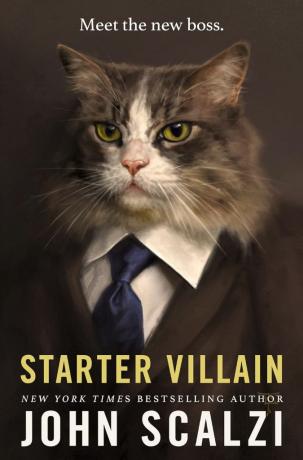
 Starter Villain by John Scalzi, Tor Books, September 19th, 2023
It may be hard to believe but the United States came really close to legalising rape in late 2012. You might scoff but this was all but a certainty according to many reputable pundits and major news sources; especially on the Internet. If the Republican candidate Mitt Romney had won, binders full of women would have been raped and the men who did the raping wouldn’t have faced any consequences at all! This was of particular interest to John Scalzi who made a timely post on his blog thanking conservative politicians for their work making it easier to rape as well as declaring his intention to vote Republican. He also claimed this was satire but it doesn’t read like that. Whatever the truth, Barack Obama won a second term and no more women were raped in the United States until after inauguration of Donald Trump in January, 2017. We will thankfully never know just how many would have been raped had Mitt Romney been elected.
John Scalzi isn’t just a rape apologist someone that is really good at getting into the mind of a rapist for the purposes of satire. He is also an author and not just any author but a Hugo Award winning and New York Times bestselling author. That I have not read any of his books until recently is a personal scandal of mine that I’m glad I’ve finally addressed by reading one of his most recent novels.
My review follows below.
The first thing to address after reading this cover to cover is the claimed genre: science-fiction. Most publications by Tor Books are in the fantasy of science-fiction genre. Most of Scalzi’s published works are in the science-fiction genre but Starter Villain is not a science-fiction novel by any stretch of the term. It is set in the present day and frequently references current things like the protagonist’s late father’s 2003 Nissan Maxima, Reddit, Facebook, Amazon, Zoom and plenty of contemporary political and economic issues. There is some mention or special technologies but none that are considered beyond the realm of possibility. The only genuine science-fiction aspects are genetically modified cats and dolphins that are sentient and play a significant part in the narrative. There is no real explanation of how they became so and readers are just told that research was done and they exist.
The novel is really more a parody of the James Bond movies (though not the novels) and I would place it in the same genre as the Austin Powers films. These films had time travel, characters being cryogenically frozen and “sharks with frickin’ laser beams attached to their heads!” but they still weren’t science-fiction films. Nor really were the Bond films they parodied despite featuring unique gadgets and vehicles that were generally beyond the technology of their time. Unlike the Austin Powers films, this book isn’t funny at all. I’m sure plenty of Scalzi’s fans found it hilarious and anyone else who finds frequent profanity and snark funny might too.
The novel is written in first-person from the perspective of a character named Charlie. He is a divorced, out of work journalist who makes his ends barely meet as a substitute teacher. He’s in his mid thirties, living in his deceased father’s home and his only friend is a cat named Hera. This all changes when he learns his enigmatic and rich maternal uncle has died and that he is the heir to his fortune. All he previously knew of this uncle was that he owned parking garages but soon discovers he is in fact a villain.
The premise is something that could work really well if done right: what if a normal guy one day found out he was heir to a cartoon super villain’s empire? Scalzi scuttles this promising premise almost as soon as the novel begins. One of his problems is he obviously doesn’t want to make his self-insert protagonist a genuine villain but still wants to call him one. Even his deceased uncle turns out not to be an actual villain but just an eccentric trying to stop real villainy through legal loopholes and other less evil methods.
Charlie is immediately annoying and unsympathetic which was one of the cues that he was a younger self-insert of the author. His annoying characteristics are demonstrated in the dialogue, which is written in the typical ‘Temu Joss Whedon’ style that is far too prevalent in modern writing:
“Make yourself comfortable,” I said to her, as I walked up to my porch.
“Thank you, I did,” she said, and then nodded at the kitten on my shoulder. “Interesting accoutrement. Do you always wear one of those?”
I petted the kitten, who was now simultaneously napping and purring on my shoulder. “They’re just terribly comfortable,” I said. “I think everyone will be wearing them in the future.”
The woman looked at me, wryly.
“That’s a Princess Bride reference,” I explained.
“No, no, I got it,” the woman assured me.
“Not to be rude,” I said, “but who are you, and why are you on my porch?”
“I’m Mathilda Morrison. I’m on your porch because before this moment, you weren’t here, and at the moment, you haven’t invited me in.”
Morrison is Charlie’s late uncle’s impossibly competent assistant and after being introduced above, becomes a major character. Though subordinate, she knows everything to the point that most of the novel could have happened without Charlie being involved at all. It would be natural for the reader to assume she will become a love interest to the protagonist but Scalzi is above such natural yet tired tropes. Instead we learn a bit later that she doesn’t need no protagonist to be her man:
It was around this time I noticed she was still wearing her dress from the Pitch and Pitch. “Very observant,” she said when I mentioned it to her. “It’s because I have a date.”
“A date?”
“Yes, a date,” Morrison said, and held up her phone. “I have a Bumble account and a life outside of you, hard as it may be to believe in the last week.”
The only real surprise is she isn’t a lesbian. The ‘Pitch and Pitch’ is from a little earlier where wannabe “tech bros” make a pitch to a group of bad guys called the ‘Lombardy Convocation’ who if not interested in the idea, will catapult the pitcher into Lake Como. The “comedy” is them pitching ridiculous things as services:
The third pitch was “testicles as a service.” “Imagine the ability to decide, on a case-by-case basis, whether you wanted your testicles to deliver sperm,” Testicle Dude said. “No more condoms, which we all hate anyway. No more vasectomies, which are painful and difficult and unreliable to reverse. Instead, there’s a nanonscale gate, built directly into the vas deferens, which you can open and close wirelessly with a phone app. We offer this as a subscription service, with a portion of the profits going to relevant charitable and service organizations, like Planned Parenthood—”
Testicle Dude launched into the air, propelled by a set of massive springs that had been coiled under the stage.
One has to presume here that the only problem the “bad guys” had was his describing “Planned Parenthood” as a “charity”. Quite a stretch of the definition and quite outrageous if you know the original meaning of the word. This group is the very one that Charlie’s uncle was working against and Charlie too takes up the reins against them. The theme of the novel seems to be that some divorced, middle-aged, unemployed, left-wing, journalist loser, would be more effective at running corporations than the actual CEOs are.
The bad guys are also misogynists which is shown in a passage that seems to be making a dig at Australian mining magnate, Gina Rinehart:
“What we do here is, how best to put it, still a male-dominated endeavor,” Dobrev said. “We could have a discussion why, I suppose, but it’s not material to our current situation.”
“We did almost invite a woman once,” Petersson said. “The Australian.”
“Roberto blackballed her,” Harden said.
“One of us in mining is enough,” Gratas said. He petted his cat, a Russian blue.
The problem with Rinehart of course is not that she’s female but that she is known to be politically conservative and that means she’d want to join the evil villains too.
In some exposition on the origins of the evil villains club as the leader is trying to convince Charlie to join, Scalzi also makes a dig at the quality of American education:
Dobrev motioned to the picturesquely looming hotel. “It’s happened here, the first. Not while I have been the owner, of course. Long before then: 1902. You know the Boer War?
“I know of it,” I hedged.
“This is your way of saying the American education system is not interested in teaching anything America was not directly involved in,” Dobrev said.
“It’s barely interested in that,” I said. “We were taught Revolutionary War, Civil War and World War II. Everything else is a little shaky.”
“The Boer War,” Dobrev continued. “South Africa. Between the British and Dutch settlers. There were two wars, actually, but it’s the second one that matters here. Ended in 1902. Was a problem.
“There’s a problem with a war ending?” I asked.
The conceit here is the idea that other nations are any more interested in the history of other nations than Americans are. The Second Boer War was one of the first international conflicts my nation was involved in (though it began before it was a nation), and it still considered a minor part of our history. Even if we were to allow that this is a deficiency in American education, Scalzi, like many with his outlook, would never suggest that it is the educators who are to blame for this. It is never their fault though and always a lack of funding and/or the party that is in government every four or eight years that prevents these problems being solved.
In any case, Scalzi Charlie bravely refuses to join this evil chud organisation:
“I don’t want to join because I’ve only been in this job for a week, and I don’t know what I’m doing, and that’s the worst time to make major decisions,” I said. “I don’t want to join because as far as I can see the Lombardy Convocation is made up of sexist old ***holes convinced of their own superiority.”
This doesn’t go over well with the evil bad guys and leads to him being attacked multiple times including a big one on his uncle’s Caribbean island/volcano lair. This is resolved through a series of betrayals and one lazy and implausible twist at the end. This twist leaves Charlie more or less where he began though with his finances in much better order. Apart from the cats and dolphins, there is little more to the narrative than this.
I didn’t reference Scalzi’s famous rape post above just to make fun of him as it also demonstrates how poorly he understands how other people think. The same is true of the novel where the bad guys motivations are simply what he imagines them to be. They want money and are bad just like Republicans want women and minorities to suffer because they are bad. There is no nuance or attempt to understand why they have the views they do. The only somewhat accurate characterisation is with Charlie and that’s because he’s a gamma self-insert of the author. All the characters he encounters find him infuriating or just irritating and I expect John Scalzi can relate to this.
Given how much he loves cats, he also seems to have little idea about their true nature as revealed in a question to his character’s sentient cat:
“Are there other smart animals? Dogs, maybe?”
NO DOGS, Hera typed. DOGS ARE THE WORST. THEY’LL SELL YOU OUT FOR A TREAT AND A HEAD PAT.
I smiled at this. “That’s good to know. The dolphins don’t seem to like you much.”
I love cats but of all creatures in the animal kingdom, they would be on the very top of the list for selling you out. In contrast, there are many examples of incredible displays of loyalty from dogs to their owners. The above would only work if the cat is lying.
As for the dolphins, Scalzi portrays them as being foul-mouthed communists shortly after they’re introduced:
I looked back to Morrison. “Uncle Jake was a union buster?” I asked.
“He was of the opinion that animals didn’t have legal standing to form unions,” Morrison said.
“How do the cats feel about that?”
“Most of them are in management.”
“Cats are ****ing class traitors,” Who Gives a **** said.
“Furry little quislings is what they are.”
The dolphins are also SJWs who have invented a label for people that don’t do what they want:
“**** him! And **** your manucentric world view!”
“Manucentric?” I asked.
“It’s not what you think,” the person in the wet suit said, getting up and coming toward me. “Manus is Latin for ‘hand.’ ‘Manucentric’ is their new go-to word when they want to accuse us of bigotry.”
**** your fingers!” the central dolphin said.
“Finger ****! Finger ****!” the other dolphins chimed in.
This might be somewhat amusing if all of this was intended to make fun of SJWs but Charlie takes their demands seriously and this is important to the novel’s resolution; or is until the ridiculous twist. He is supposed to be the “starter villain” and yet he allows the dolphins to unionise and gives them “reproductive rights” so they will help him defeat the real evil bad guys.
Before settling on this book, I was originally going to borrow his Hugo Award winning Redshirts but it wasn’t available at my local library. I chose this one expecting that he would have improved his craft in the twenty years he’s been writing. Yet, this was worse than I could believe and I’m confident that had Scalzi not already had a recognisable name, that this would never have been published. It reads much more like a young adult novel than proper science-fiction; only with a lot of cursing and general self-indulgence. A look at the Amazon page suggests it must have sold somewhat decently and is generally well reviewed so I doubt my opinion will bother him too much.
Scalzi is known for being a derivative author with his breakout novel Old Man’s War being based on Robert Heinlein’s Starship Troopers and his Interdependency trilogy based on Isaac Asimov’s Foundation series. I couldn’t detect the ideas of a better author in this and so this might be the closest thing to an original novel he has written. If so, it shows that even with a decent premise, he will still face-plant the execution. What will protect him though is his real gift which is spruiking himself. So even with terrible books like this, I don’t see him going anywhere even if Tor Books were to go bankrupt tomorrow.