
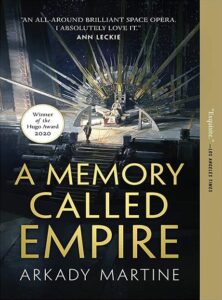
 A Memory Called Empire by Arkady Martine, Tor Books, March 26th, 2019
While writing my post on Andy Weir last month, I had looked up the work that his most recent novel, Project Hail Mary lost to in the 2022 Hugo Awards which was A Desolation Called Peace by Jewish author Arkady Martine. It is a sequel to her debut novel, A Memory Called Empire that also won in 2020 which means the only two novels she has written (as of writing), have won the Hugo Award for best novel. This puts her wins one short of the latest “SFWA Grand Master” N.K. Jemisin in total wins but even Jemisin’s debut novel was only nominated for best novel and she had to churn out a few more before finally winning. This had me curious to see how one of her novels compares to Andy Weir.
As I have done previously, I looked up a copy of her novel in the local library and very unlike my experience with Andy Weir, found a copy without any pending holds. I finished it just recently and have my thoughts detailed below. I will state before proceeding that this is the last time I plan to do this. Between this, John Scalzi and N.K. Jemisin, I believe I have read enough to know for sure that my assumptions about modern Science Fiction and Fantasy are accurate. And I really don’t think I need to further punish myself with authors like Ann Leckie or Mary Robinette Kowal to establish this definitively. According to Fandom Pulse, the latest winner by Alix E. Harrow was a romance clothed in the loose-fitting garment of fantasy. So outside of a male author winning last year, nothing has changed in the last few years and I don’t intend to do this again unless I can have fun doing it.
Now, onto the novel.
The front cover of the paperback I borrowed has a quote from Anne Leckie, describing A Memory Called Empire as “an all-around brilliant space opera.” It is described as a “space opera” two more times on the inner and back cover. I was puzzled by this description long before I finished reading it and was more than certain it didn’t fit by the end. The top definition on Wiktionary for “space opera” is:
(initially derogatory) A subgenre of speculative fiction or science fiction that emphasizes space travel, romantic adventure, and larger-than-life characters often set against vast exotic settings.
John C. Wright’s The Golden Oecumene trilogy certainly fits this definition but this novel absolutely does not. It is set within a vast space empire with the potential for adventures across strange worlds but the novel takes place almost entirely within a large city at the seat of this empire. Another quote from Library Journal is closer to the real genre when describing it as a “SF political thriller”. One can easily quibble with the definition of genres and the way they blur together and I certainly have, but like so many poorly-disguised romances, the science fiction elements are unnecessary. There are more elements of political a political thriller than anything else but A Memory Called Empire (and presumably its sequel), can more simply and accurately be defined as “Chick lit”.
The first paragraph about “Chick lit” on Wikipedia states that it:
… is a term used to describe a type of popular fiction targeted at women. Widely used in the 1990s and 2000s, the term has fallen out of fashion with publishers, with numerous writers and critics rejecting it as inherently sexist. Novels identified as chick lit typically address romantic relationships, female friendships, and workplace struggles in humorous and lighthearted ways. Typical protagonists are urban, heterosexual women in their late twenties and early thirties: the 1990s chick lit heroine represented an evolution of the traditional romantic heroine in her assertiveness, financial independence and enthusiasm for conspicuous consumption.
As will be demonstrated from what follows, this is a more accurate genre for the novel outside of the science fiction and thriller elements. The only other notable difference to what is described above, is the protagonist shares the author’s sexual perversion.
I suppose someone could respond to my opening criticism by claiming that the plot of Dune could work just as well in Central Asia in the 19th century using the conflict between the British, Russian and the various little despotic kingdoms that populated that region at the time. This was where Herbert drew part of his inspiration and I would agree it could be done but then, Dune would have been considerably less interesting without sandworms, crysknives, stillsuits, spice among many other elements that make it so unique. The science fiction setting truly complimented the narrative in a way that it doesn’t in An Empire Called Peace.
The novel begins with the protagonist, Mahit Dzmare being sent from Lsel Station to become the new ambassador for her people in the capital city of the Teixcalaan Empire. Her predecessor has died in mysterious circumstances though officially from anaphylaxis; an explanation that is met with incredulity by Mahit from the outset. On arrival she is introduced to her cultural liaison, Three Seagrass and yes, that is her name and you’ll need to quickly get used to it and a number of others like it if you’re to finish the book.
If you’re already guessing the inspiration is a space-faring Aztec Empire, then you would be correct. The naming conventions are explained early on with Mahit and Three Seagrass chuckling together about someone named “Thirty-Six All-Terrain Tundra Vehicle.” While I am aware that this is supposed to be otherworldly and based on naming conventions for Aztecs and/or other Native American tribes, it doesn’t make the decision to include them less silly. Martine could have just as easily explained the meanings of the names while making them more readable. Imagine referring to someone named Theodore for example as “Gift of God” in regular conversation. “Mahit” sounds relatively normal in comparison to “Teixcalaanlitzlim” names like “Nineteen Adze”, “Five Agate” and “Thirty Larkspur”.
From here, Mahit’s adventures largely consist of going to parties, eating lunch, having meetings and checking her emails. This is not a joke or an exaggeration and the only difference is the emails are called “infofiche sticks” which are just ornate USB drives with wax seals and other decorative marks. They’re functionally still “electronic mail”. Martine even has her protagonist complain about having to send emails at one point:
THE problem with sending messages was that people responded to them, which meant one had to write more messages in reply.
This all sounds suspiciously like what the author and most of her audience considers “work” and it is far too mundane to include in a novel described as a “space opera” or a “political thriller”. Like almost everyone today, I have to respond to emails as part of my job but it is usually the easiest part and often a relaxing break from my main duties. Something else Mahit and Three Seagrass do is discuss language:
The Sunlit use of the first-person plural was unusual and slightly disconcerting. That last “we” ought to have grammatically been an “I,” with the singular form of the possessing verb. Someone could write a linguistics paper, for girls on stations to gush over late on sleepshift—
And poetry:
“Are you going to finish the drink?” asked Three Seagrass when the noise had died away.
“Yes. Why?”
“Because I am going to have to talk about Fourteen Spire’s use of assonance for the rest of the evening, and you’re going to have to listen, and we should both be slightly more inebriated.”
“Oh.” said Mahit. “When you put it like that.”
In the Acknowledgements section, the author states she began writing the book “two weeks into an intensive language course in Modern Eastern Armenian” and the short biography on her website indicates she has a job that requires her to travel and send emails. If it is not already clear, “Mahit” is a self-insert that shares the same interests as the author. The author is also a lesbian and Mahit and Three Seagrass become space lesbians towards the narrative climax; though thankfully without any of the smut that her peers tend to include in their works.
So quite revealingly, this is a novel written by a Jewish lesbian about a lesbian female from a nomadic alien race that uses her position to interfere in the political machinations of a powerful empire for her own nation’s benefit.
Martine also really likes to use italics and particularly for words like “alone” as demonstrated here:
She got up, walked over (heel-toe, just to see) and swept her hand through them. Dust. Dust motes. No air scrubbers in the Jewel of the World. There was a sky, too, and plants. Just like other planets she had been on, those brief visits. She was being ridiculous. It was only that everything was strange and she was so alone that was making her have these flights of paranoid fantasy.
Using quotations on WordPress automatically italicises everything and already italicised words become regular so I have deliberately reversed it here to render it exactly how it is in the text. I have done the same for the next quote which is found towards the end of the book and neatly includes almost everything I dislike about the novel:
“You realize,” he was saying, “that what you just did—sending unauthorized political poetry on the public feeds—might be construed as treasonous? Particularly considering where you were picked up and how Belltown Six is full of anti-imperial protestors this morning, not to mention the rest of the mess in the City?
“Take it up with the Judiciary,” said Twelve Azalea. Mahit was proud of him. They were all going to die, or . . . something and yet—they were a we. By whatever the language’s definition.
I have written political poetry appropriate to the current moment of my experience,” said Three Seagrass. “If that’s treason, take it up with our two thousand years of canon. I’m sure you’ll find more treason there.”
Six Helicopter tried not to sputter, failed. With his hands full of cloudhooks, he couldn’t gesture properly, but Mahit could see in the tension of his shoulders and his jaw how much he wanted to wave his hands, or shake Three Seagrass, who sat serene with her chin cupped in her palms, elbows on the table.
Silly names, italics, ellipses and masturbatory asides about language all in one. It also includes one of the more laughable themes in the work which is the idea that talking and writing bad poetry can be used to overcome serious problems. When not licking the back of her spoon at a lunch meeting after a morning of checking emails, Mahit sometimes finds herself in danger. There are a few attempted assassinations and one where she overcomes and kills her male attacker with his own weapon. Martine does at least go to the trouble of explaining that her race are larger than the “Teixcalaanlitzlim” but even as she tells it, it comes across implausible. Moments like these are few and far between but these, along with some of the political intrigue make it lean but never truly become a genuine political thriller.
The above quote also has what is somewhat erroneously called “Millennial Writing” that has become all too common across most media in the last decade. Though again more restrained than her peers tend to be, Martine still can’t resist it in a few moments like this after the attempt on her life just mentioned:
“Mahit, most people don’t—”
“Get ambushed by strangers with terrifying weapons in their own apartments while evading their only political ally in order to have a secret meeting on a foreign planet? No. I assume that doesn’t happen to Teixcalaanlitzlim.”
That doesn’t happen to anyone,” Three Seagrass said. “Not as a rule.”
“Wow, someone just like totally just tried to assassinate me!”
And towards the end we even get an actual “did that just happen?”
“Did that actually just happen?” she asked. “Did some jumped-up bureaucrat without an inch of training in protocol just tell us that the Information Ministry is under the control of the ezuazuacatlim? Because I think that was what just happened, and I am at a complete loss; do forgive me, Mahit, this is not within my ****ing portfolio of plausible scenarios that I might encounter while acting as cultural liaison to a foreign ambassador.”
The four letter word beginning with “f” does appear from time to time but unlike Jemisin, she didn’t make up an alternative only to make frequent use of it anyway.
There is also some unsubtle and usually clumsily written socio-political subtext included with this reference to terms like “colonialism”:
Mahit said, pointedly, “We manage, and watched Five Agate curl her lip up, wry, noticing that she’d slipped—the unconscious assumption that everyone in the universe would want exactly the same things as a Teixcalaanli person would want. Mahit took some pity on her, and said, “Though we remain ignorant of why Thirty Larkspur was worth of being associated.”
Women’s “reproductive rights” also get a mention after a character proudly reveals that she had a child from her own body which in the author’s fantasies, is an exception to the rule:
That was unusual on Teixcalaan—unheard of on Lsel. A woman using her own uterus rather than an artificial womb to grow a child was a luxury of resources the Station simply didn’t have—women died doing that, or destroyed their metabolisms or their pelvic floors, and women were people who could be doing work. Mahit had been given her contraceptive implant at the age of nine. When she’d learned that Teixcalaanlitzlim sometimes bore their own children inside themselves, she’d thought of it the way she thought about the water spilling out of one of those flower bowls in the restaurant in Plaza Central Nine. To have that much to easily spend felt both offensive and compelling
I include this mostly because it shows what the only real appeal of speculative fiction is to women like this outside of selling their books with deceptive labels. They like the idea of being freed from reality and its consequences by either magic or through some imagined scientific advancement they take no care to think about beyond it’s direct benefit to their disordered desires. It is supposed to be a good thing that babies can be grown and raised elsewhere so women like Mahit can travel, got to restaurants and have sterile intimacy with whatever person or object takes their fancy in the moment. All the “work” she does in the novel is essentially useless and it says a lot that she thinks lunch meetings and reading emails are more important than having children.
Modern gender politics also get a fleeting mention to check all the necessary boxes:
Three Seagrass took a turn, and then another woman, and then a Teixcalaanlitzlim of a gender Mahit didn’t recognize, and then it was back to the initial challenger…
The only science fiction elements present in the novel outside the setting is something connected to Mahit’s brain called an “imago” machine which contains a likeness of her predecessor that she can communicate with. It malfunctions near the beginning and becomes important in itself as certain people within the empire desire to learn about it and she wants to reconnect with her predessesor. The Teixcalaanlitzlim also use a machine that attaches to their eye called a “cloudhook” which can be used for identity, communication, getting information and security verification; so it is really just a Smartphone that attaches to their eye which is technology that already exists. The rest enabling mundane stuff like interstellar travel are just assumed without explanation and like the “cloudhook”, much of the technology encountered is well within the realms of what exists now. Science fiction novels don’t have to explain everything but Martine shows little interest in the few she bothers to describe outside of their utility to the plot.
If not just another “Chick lit” novel, I could see this working as a political thriller set in Mexico City where a progressive US president appoints an open lesbian as an ambassador to Mexico. In the course of her duties, there are attempts on her life and she falls in “love” with her Mestizo assistant. Everything here would work just as well without the superficial science fiction elements. But even describing it as a political thriller is far to generous given that it is mostly a boring read about lesbians going to meetings and parties in a city that is about as alien to her audience as New York city where she grew up.
This is not a novel for readers that enjoy science fiction, it is a novel for people that use science fiction and fantasy as a façade to write about themselves and people like them.