
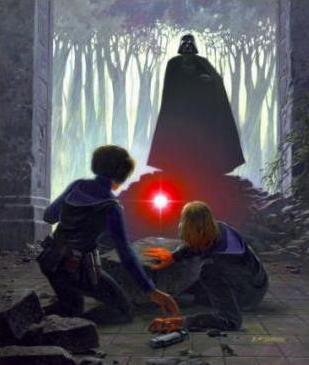
Splinter of the Mind’s Eye is a Star Wars novel published in 1978 that directly follows the events of the first film. It was written by Alan Dean Foster who also ghostwrote the original film’s novelisation. As it is the first original novel published in what later became the Star Wars Expanded Universe and it released before the direct theatrical sequel The Empire Strikes Back, it has become a curiosity for Star Wars fans. I bought a copy of a paperback reprint from the mid 1990s a few years ago and finally got around to reading it recently.
I have written a number of posts lamenting the sad descent of the Star Wars franchise which has accelerated significantly since Disney acquired it over a decade ago but Splinter of the Mind’s Eye demonstrates that some of these problems existed early on. The one most evident in this is the dependence writers have on the films and how little invention there is outside of them. This is certainly true of this novel which introduces almost nothing not found in the original film. This was mainly by design as Foster was contracted to write this before Star Wars became the cultural phenomenon it… was. The scope was also intentionally restricted by Lucas.
The novel is set shortly after the original with Luke, Leia along with R2-D2 and C-3PO on a diplomatic mission to a planet called Circarpous IV. The details of this mission don’t really matter as they end up crash landing on the neighbouring swamp planet Mimban (Circarpous V), where the entire book takes place. Outside of an implausible appearance of Darth Vader towards the end, these four are the only returning characters from the first film. The description of the planet reminded me of Yoda’s swampy hermitage on Dagobah and it can be assumed this was an influence for this location in The Empire Strikes Back.
Had this book been used entirely to develop the script for the sequel, there would have been very little star wars in the Star Wars sequel. After crashing, Luke, Leia and the droids sneak around what they soon discover to be a clandestine Imperial mining operation before being captured, escaping and going in search of a MacGuffin called the “Kaiburr crystal”. There are some new characters including an old woman named Halla who starts them on this search and Captain-Supervisor Grammel who is the main antagonist right up until Vader kills and replaces him near the end. There are a few other aliens including two large “Yuzzem” named Hin and Kee who they meet in the prison cell and soon become allies. There are also some underground creatures called Coway who hinder them before also becoming their allies towards the novel’s climax.
As mentioned, Darth Vader does make an appearance and there is a confrontation between him and Luke. Surprisingly, Luke comes off the victor though Vader conveniently falls down a hole, leaving his death uncertain. As if this were not enough, Luke voices as much after his disappearance. Another interesting occurrence is that Luke is initially trapped when Vader arrives to confront him and so Leia initially fights him and is left for dead. Thankfully the MacGuffin is sensitive to the Force which enables Luke to use it to heal her injuries. It apparently couldn’t be used to heal poor Hin and Kee who are killed or mortally wounded by Vader before he gets to Luke and Leia. The novel then ends rather inconclusively with the four characters still trapped on the planet.
Although it is interesting to read what could have been, I’m glad that this wasn’t the direction the eventual sequel went with. The Empire Strikes Back takes places across multiple planets with more characters and with significantly higher stakes. The confrontation between Luke and Vader, even without the famous revelation near the end; is considerably better done than the climax found here.
Some other interesting aspects are just how undeveloped certain staples of the series were at the time. As with The Empire Strikes Back, there was no suggestion that Luke or Leia were siblings and Foster continues to develop a romantic connection between the two that is further strengthened by the absence of Han Solo. It is also stated directly that Leia is not sensitive to the Force which further severs any idea of kinship the two have as revealed in Return of the Jedi.
I don’t blame the author for any of this as he wrote what he could within the limitations placed on him. As a result of this, it is only really interesting for the few influences it had on the series and as a counterfactual example of what a low budget sequel might have been had Star Wars not been so successful. It also more fittingly set a standard for how limited future Star Wars novels and other media would be by the films; a limitation not really broken until there were more films made beginning (for better and worse), with The Phantom Menace in 1999.