
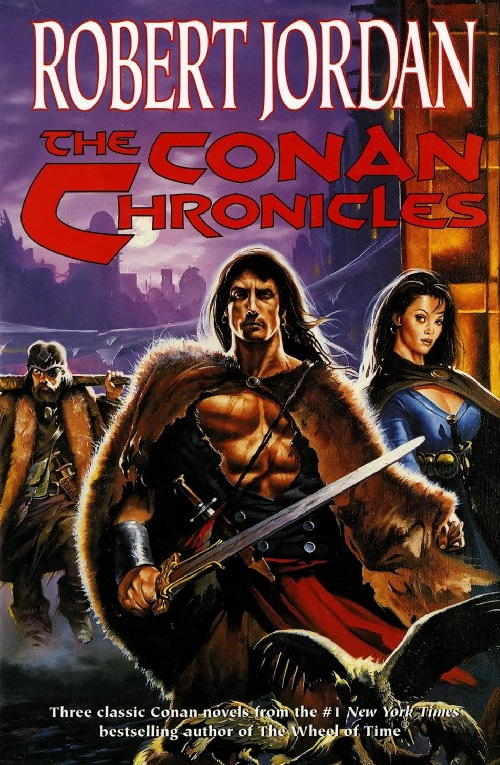
 The Conan Chronicles by Robert Jordan, Tor Books, June 15th, 1995
Robert Jordan is an American author best known for his The Wheel of Time fantasy series which began in 1990 with The Eye of the World and spanned fourteen novels; the last three being written by Brandon Sanderson after Jordan’s death in 2007. Prior to his breakout success with this series, he was commissioned to write a series of Conan pastiches including the novelisation of the 1984 film, Conan the Destroyer through publisher Tor Books. He was one of many authors to take on Robert E. Howard’s character during this time and he even produced his own series chronology placing his and other author’s works with Howard’s.
Though I’ve not read any of The Wheel of Time series, I was interested in his Conan pastiches as I’d been led to understand they stood out from the crowd. The collection to be reviewed here includes the first three of his six original novels collected into an omnibus. The other three are collected in The Further Chronicles of Conan with only his novelization of Conan the Destroyer being omitted.
As mentioned, these were originally standalone novels published by Tor Books in the 1980s and with many covers inspired by if not created by Boris Vallejo. The omnibus copy I got was released later and I think might have been lazily scanned as there are a number of errors with the most egregious being “if” frequently replaced by “an” across all three novels. This is not Jordan’s fault but I would avoid the above edition as I doubt the copy I read was the only one with this flaw.
As for the quality of novels themselves, the short answer is they’re all better than S.M. Sterling’s Blood of the Serpent which I reviewed a few years ago and likely by extension, all more recent novels which find Robert E. Howard’s original works “problematic”. They’re not better than Chuck Dixon’s two (briefly) published pastiches that I also reviewed on this blog. If this is enough to recommend them, then don’t let me stop you but I offer a critique beyond this.
The three novels included in this omnibus are Conan the Invincible, Conan the Defender and Conan the Unconquered. The first book is set sometime after Howard’s The Tower of the Elephant. The second before Queen of the Black Coast and the third after Rogues in the House. Howard himself had no confirmed timeline so Jordan’s order can be safely ignored and all three novels stand on their own with only two characters reappearing outside of Conan himself.
All three novels also have an evil sorcerer as Conan’s main antagonist with only the setting and characters distinguishing them in any meaningful way. Even the names of these sorcerer’s aren’t that different with Amanar the first, Albanus the second and Jhandar the third. After finishing the third novel, I went and checked the last three of his novels and they also have sorcerers as the antagonists though one is more accurately a sorceress. Howard was no stranger to repetition and/or recycling concepts but most of his Conan stories are more varied than this. As these were pastiches he was contracted to write for Tor, Jordan may have had some specific restrictions on what he could write but whatever the truth is, the plots all lack creativity. So much so that even with all three fresh in my memory, they have already begun to blend together and I had to flick back through them as I was writing this review.
Something else all three have in common is women with large breasts. If the reader is ever wondering about the bust size of a female character, Jordan is sure to share a description within the first few paragraphs of their introduction and perhaps a few more times if they are important enough. If I’d known prior to reading, I would have had some small amusement making a tally but some examples should suffice:
…the olive-skinned woman across the small room, who was adjusting the gilded brass breastplates that displayed rather than concealed her swelling bilobate chest.
This is the first woman introduced in Conan the Invincible and she disappears only a chapter later. As I learned soon after reading, “bilobate” means “divided into two lobes”.
Shortly afterwards, an original character named Karela is introduced. She also appears in Conan the Defender and two of the three later novels in the second omnibus. Her description is rather brief:
She was an ivory-skinned callimistian delight, all curves and long legs and rounded places.
She also has auburn hair. “Callimistian” apparently means ‘beautiful breasted‘ though I’d never encountered the adjective before reading this and I’d have had a hard time discovering the definition without the Internet. A few pages later the reader is told that:
her heavy round breasts shifted beneath the tight green tunic.
This is also often the extent of the description of the women in the novel. The colour of their hair and how large and round their breasts are. Sometimes height or skin colour is mentioned but the latter as often as not is in relation to their breasts. He often also repeats these descriptions with “full-breasted” appearing a lot too. Even “callimastean” gets another mention in the second novel:
She was no slender girl, but a woman of curves, a callimastean and callipygian marvel…
“Callipygian” apparently refers to a rounded backside but I’d given up learning obscure words for the lecherous by then. Thinking about it, I’m not sure whether any woman of any importance in the novel doesn’t have large breasts. Howard was not innocent of offering such descriptions but I don’t recall him doing so with anywhere near as much frequency or enthusiasm. While I certainly understand how a man could become preoccupied with a woman’s breasts, I don’t think it was necessary to give them as much attention as Jordan has in these three novels. As with the plot outlines, this may have been part of the contract but again, I can’t say.
Karela is also known as the bandit “Red Hawk” and quite similar to Valeria from Red Nails though with auburn instead of Valeria’s “unruly golden hair”. Outside of this cosmetic difference (Valeria is also “full-bosomed”), she is so similar that I don’t quite know why Jordan didn’t just use Valeria instead. Her loyal eye-patched subordinate Hordo is a little more original and a more compelling character. At the very least, he shows some growth; going from distrusting Conan to becoming a friend over the course of two of the novels. Karela is essentially an exaggerated Valeria and her hair colour only furthers the stereotype about red-heads and their tempers.
There are of course more to these novels than sorcerers and large-breasted damsels. All three at least vary in how Conan eventually comes to confront the sorcerers. Though formulaic, the novels are at least engaging and I read through all three rather swiftly. Robert Jordan makes use of many of the tropes found in Howard’s novels but seldom tries to imitate him directly. This is a positive because I don’t think he would have succeeded had he genuinely tried.
As of writing, I’m not sure if I’ll read the next three but I can see why they are well-liked though Howard’s originals are still the best place to start for new Conan readers. These are really only recommended for those that want more of the character beyond re-reading the originals.