Arnold Schwarzenegger and Sylvester Stallone spent the better part of the 1980s in friendly competition with multiple now iconic action films released during this decade. Schwarzenegger started with Conan the Barbarian and had continued success as the titular antagonist in The Terminator then Predator and Commando among a number of others. At the same time, Stallone continued his Rocky series into the 80s which also embraced the decade’s muscular machismo as did the Rambo films after First Blood in 1982. They continued to dominate the genre into the 1990s but it was also around this time that they took on more comedic and sometimes a more “family friendly” turn. Although still containing plenty of graphic violence, even Terminator 2: Judgement Day was unsubtly marketed towards pre-teen boys with ten-year old John Connor and his own personal killer robot. I know this is true because I loved Terminator 2 when I was around the same age and my mother (very reluctantly), allowed me to watch it with my brothers. If my personal anecdote doesn’t convince you, the toys and video games produced at the time of the film’s release should.
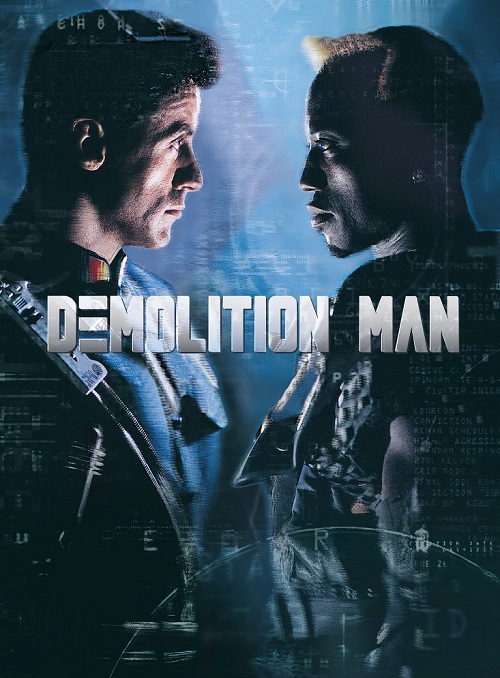
Some more examples of the family-friendly (but not really), films are Kindergarten Cop and Sylvester Stallone’s bizarre but somehow still forgettable Stop or My Mom Will Shoot. Both actors continued doing action films but many of these had a more light-hearted tone. For Schwarzenegger, there was the poorly received but still entertaining The Last Action Hero and Stallone had the more memorable Demolition Man; the latter which is the subject of this post.
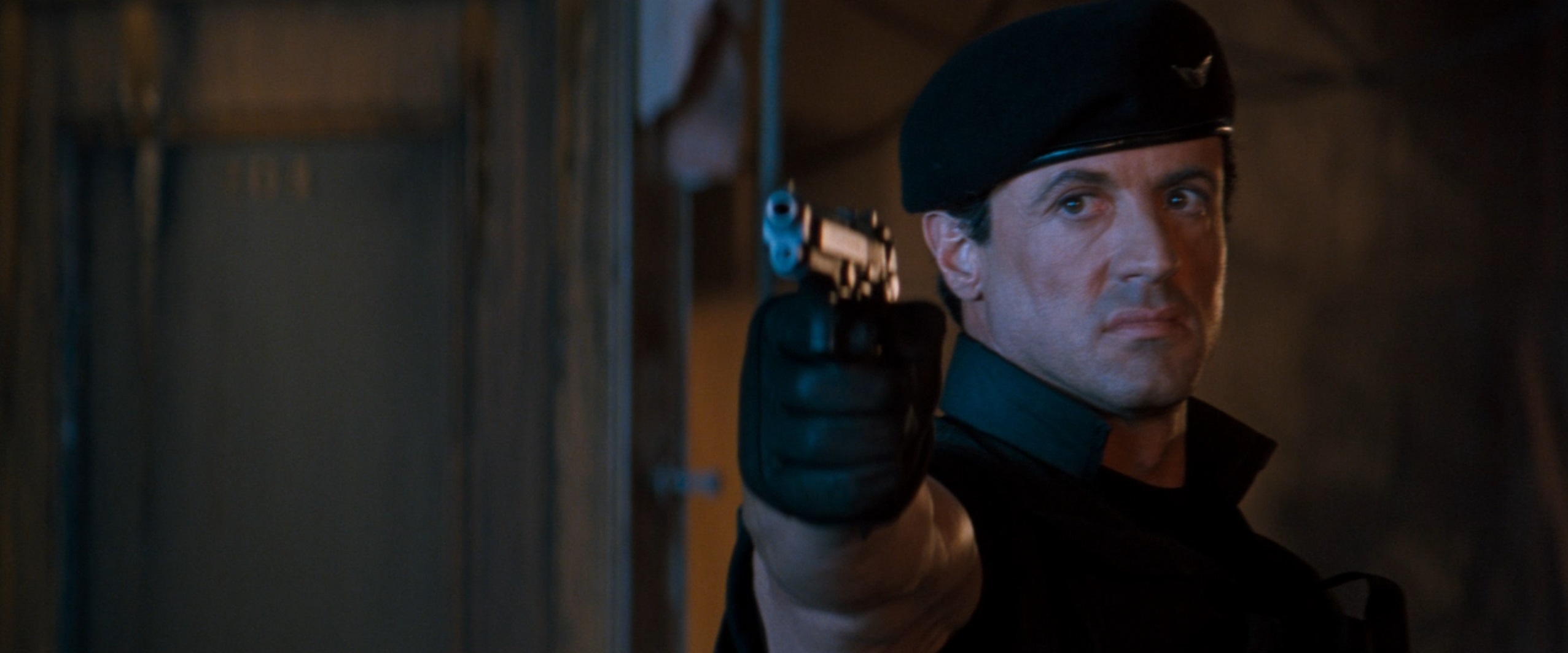
Demolition Man is one of those films that shouldn’t work but does. It is an action film with a science-fiction premise and social commentary with a first-time director Marco Brambilla at the helm. The film opens in 1996 (just three years after the film’s theatrical release), depicting a Los Angeles in flames. For some context, the L.A. Riots of 1992 were no doubt firmly in mind but I still remember laughing when I first saw it on television sometime in the mind 1990s. In this opening we are quickly introduced to John Spartan played by Stallone who utters the line, “Send a maniac to catch one” before leaping from a helicopter while hooked to a bungee cord. The maniac he is after is Simon Phoenix played by Wesley Snipes. Spartan fights his way through to Phoenix and though successfully detaining him, discovers he has been set-up as the people he came to rescue are found dead in the destroyed building. Spartan is held partially responsible and charged with Phoenix and both are cryogenically frozen as punishment.
The film then moves forward to the year 2032 in San Angeles a peaceful and beautiful but fictional metropolis covering Santa Barbara through Los Angeles and San Diego. One of the criticisms of the film (even at the time), was the chosen setting. 1996 quickly turned out to be a bit premature with regards to the total collapse of the United States as we know it. Thirty-six years is then also far too optimistic a length of time for a picturesque utopia to rise out of it. With the acknowledged benefit of hindsight, 2032 would have been a better setting for the film’s opening and at least a century after that would have been a more plausible future date. Just in 2025 there was serious civil unrest in Los Angeles and many parts of the city now much more resemble the chaos in the film’s opening than was true in 1996. This is at least from my understanding as in my only visit to Los Angeles, I never left the airport.
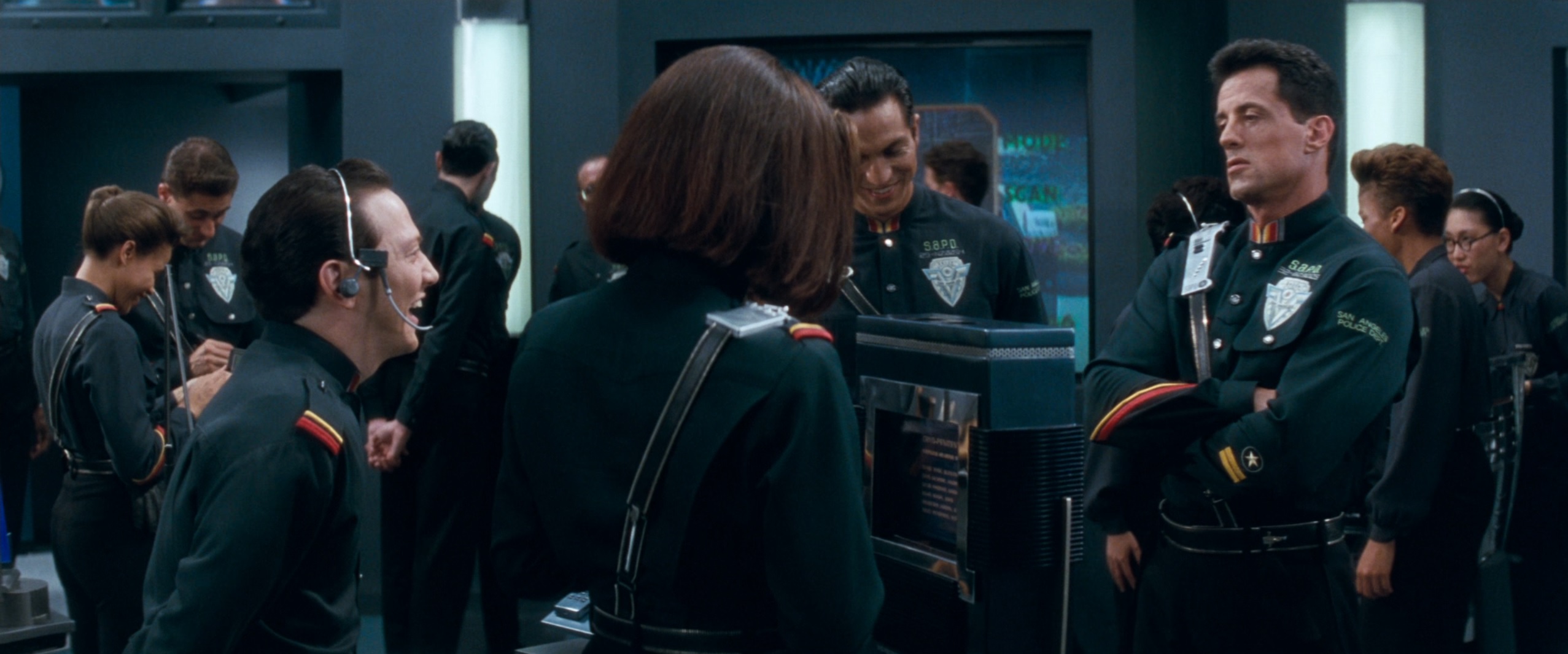
Still, the film works even with this quibble as these years can quickly be forgotten. The audience is introduced to the utopian San Angeles through the eyes of police officer Lieutenant Lenina Huxley played by Sandra Bullock. Huxley is bored with the lack of excitement in her job (though I’m sure most contemporary Los Angeles police officers would prefer it). She is also later revealed to be an aficionado of the violent twentieth century, having a collection of memorabilia from the period as well as quite a number of misconceptions about what it was actually like.
Simon Phoenix is taken out of cryostasis for a parole hearing that he soon escapes; committing multiple now unthinkable homicides in the process. The San Angeles Police Department are not equipped to deal with this and even have to look up the criminal code “187” that twentieth century police officers were very familiar with. These future police have no experience dealing with violent criminals, nor are they equipped with adequate weaponry as all firearms are outlawed. Phoenix is then easily able to overcome multiple police officers leaving the entire department in disbelief.
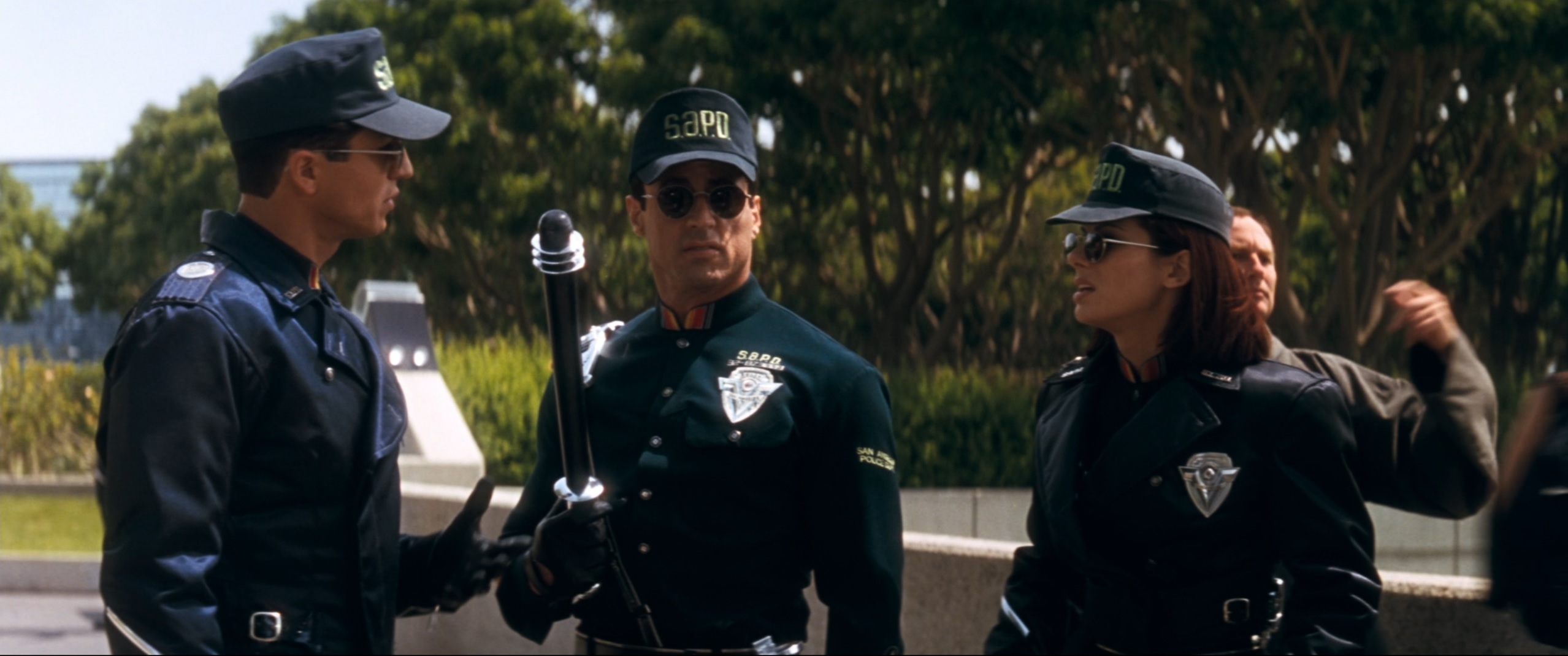
The solution presented by an older officer who was alive in 1996, is bringing back John Spartan who it is rightly assumed will be able to stop Phoenix where they have failed. This also suits Huxley who gets to partner up with someone she idealises as the model of twentieth century manhood. While Phoenix immediately sees the advantage someone of his ruthless character can have in a society like this, Spartan initially struggles and often comedically so. He is confused by the dangerous naiveté of the people he meets including Huxley who throughout the film excitedly enthuses about his time as well as uttering a number of amusing malapropisms while trying to imitate the coarser lingo of the late twentieth century.
The reason for Phoenix’s release are soon revealed to be more sinister than accidental with the dear leader of this utopia Dr. Raymond Coctea (Nigel Hawthorne), revealed to be behind his escape. His purpose is to use Phoenix as a tool to wipe out the last remnants of the previous world’s ideas by killing Edgar Friendly (Denis Leary) and his underground resistance.
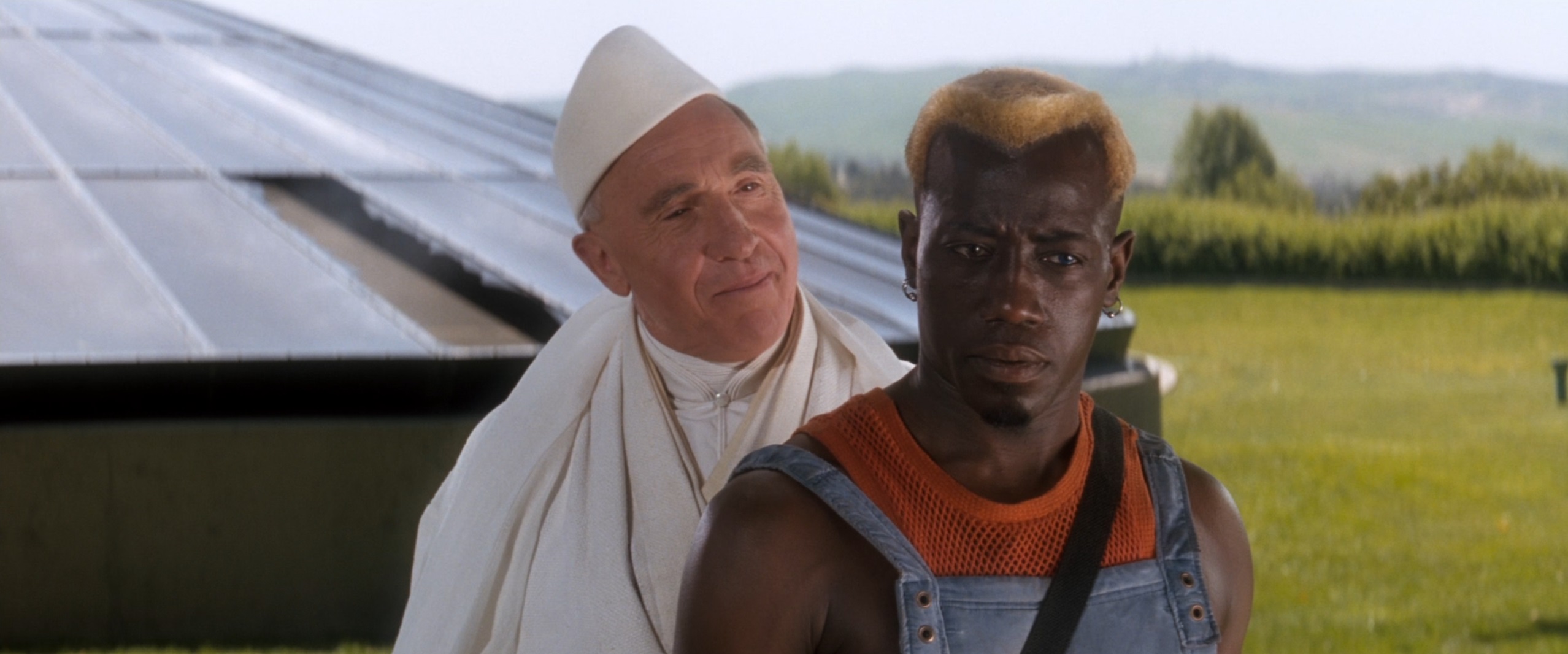
With all these notable actors, it is interesting to think how fortunate the producers were in their casting. At the time, Stallone was the biggest name and Wesley Snipes and Sandra Bullock were known but mostly for supporting and/or ensemble roles. Wesley Snipes did already have a few lead roles behind him but after the following year’s Speed, Bullock would go on to many more herself. English actor, Nigel Hawthorne probably wasn’t well-known to American audiences but was well established in theatre and more popularly as Sir Humphrey Appleby in Yes, Minister and (at least to me), as Archdeacon Grantly in The Barchester Chronicles which adapted the novels, The Warden and Barchester Towers by Anthony Trollope. Then there is Denis Leary, who is an actor but was better known as a stand-up comedian and his character Friendly is certainly inspired by his comedic persona. Even other supporting actors are notable (or would be in the coming years), including Glenn Shadix, Benjamin Bratt, Rob Schneider and even Jack Black as an easily missed extra.
Though there is some great action, it is much better appreciated as a satire. In its way, it makes for a more subtle and clever deconstruction of the action genre than Schwarzenegger’s The Last Action Hero quite intentionally did the same year. They both contain well-meaning digs at each other too with Huxley revealing Schwarzenegger had become president after the passage of a “61st Amendment” allowing the foreign-born take office where the latter film had an alternate reality where Stallone starred in Terminator 2 — both prompting disbelief. These were somewhat prescient too as Schwarzenegger did at least become governor a decade later and it seems likely we’ve now had at least one foreign born president elected in 2008. Kamala Harris at least (assuming you first accept the legitimacy of the 2020 election), should not have been eligible as vice president or to run for president in 2024 as both her parents were foreigners.
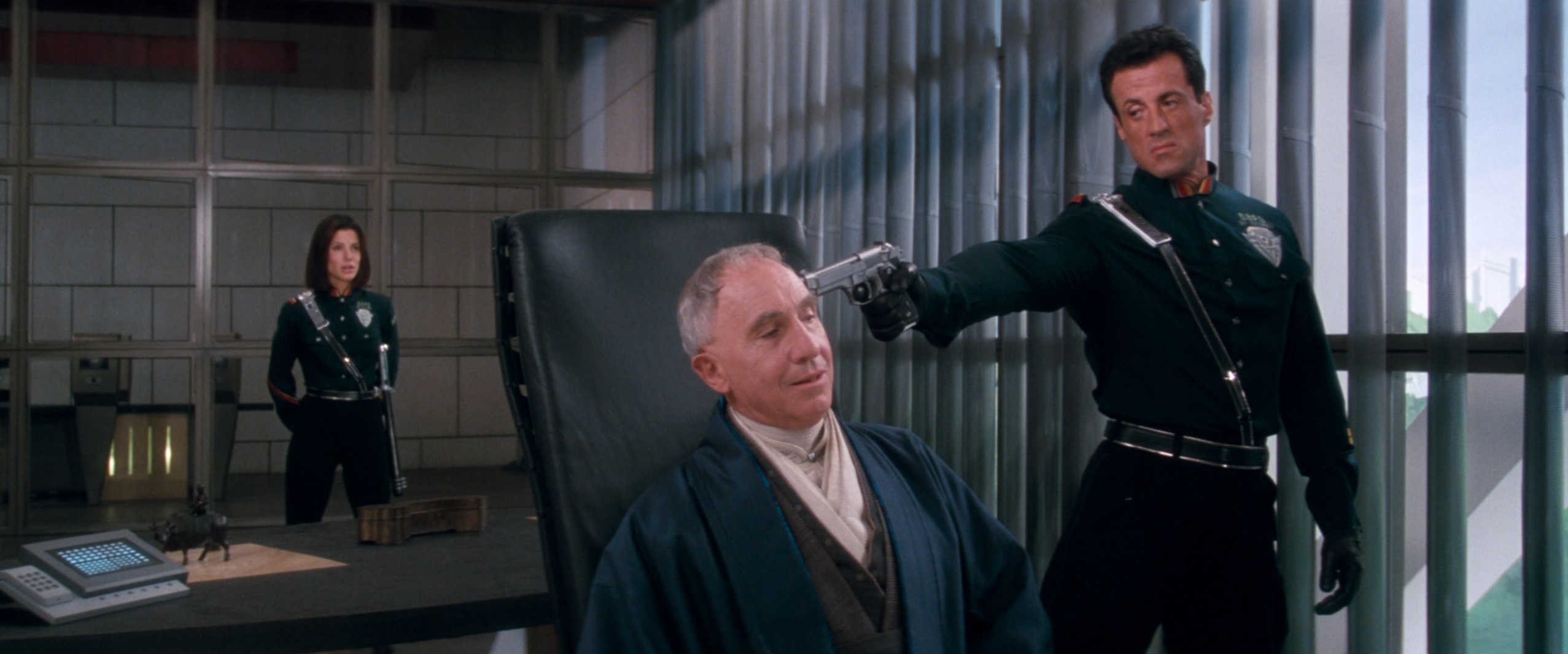
If not obvious, Bullock’s character’s last name points to the author of Brave New World, which I confess I’ve not read but partially inspires the setting. The society is quickly revealed to only be outwardly utopian and inwardly malignant. Citizens are essentially modern lotus eaters with no ability to detect, let alone defend themselves from dangers. “For their own good”, they’ve even been forbidden and cultured to consider the marital act disgusting and birthing is controlled by the state. Citizens use virtual reality to experience the act in a recreational sense which particularly bothers the more visceral Spartan. It is also this aspect that both repels and attracts Huxley and other characters to him as barbarian in this new civilisation. Whereas Phoenix both exploits and delights in the weakness of the society, Spartan struggles in his natural role as an enforcer of a system he quickly finds he detests. The immediate danger of Simon Phoenix represents is all that then drives him. As the film progresses, Dr. Coctea is destroyed by the monster he unleashed, being confident of controlling him until just before his violent end. Friendly is revealed to be much less a threat than a freedom fighter and while pursuing Phoenix, Spartan through his resolve, is able to undermine the happy dictatorship.
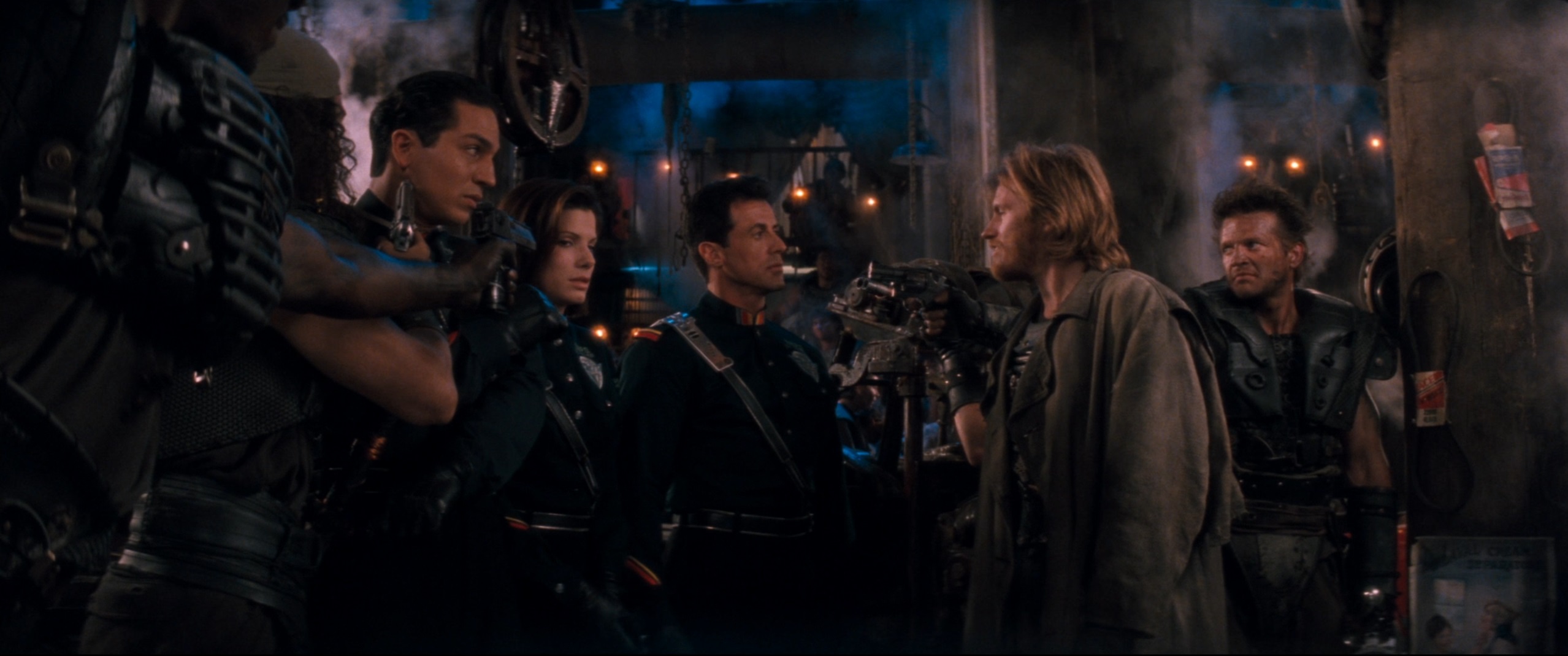
Something else I noticed in a recent re-viewing it was the oriental influence on the costumes and set design. At the time, the influence of Japanese culture on American society was still strong as seen in the film Rising Sun which also starred Snipes and came out just a year prior. The elegant and pacifistic society of the modern Japanese was seen as a possible influence on the future, at what was then still “The End of History” after the fall of the Soviet Union and the prematurely declared triumph of American liberal democracy.
The above also brings another absurdity you’re supposed to ignore and that is the idea that the rest of the world would either submit to or leave such a society alone. From memory, it is not made clear in the film whether this is a single city or something true of United States and the rest of the world as a whole. Dr. Coctea supposedly founded it and lives within the city and everything takes place in what appears to be a very small geographic space. As with the dates used, this doesn’t really hurt the film unless you spend too much time thinking about it.

As to it’s continuing relevance, it is largely due to aspects of the film coming true. The same group that once championed “free expression” and all manner of sexual licence, has now become in many ways prudish and certainly shows hostility to beauty and anything resembling normal human relations. Though not religious, there are increasing restrictions on speech and conduct which it is claimed are to avoid “offending”. Our overclass shows both reluctance and an inability to deal with genuine threats and frequently punishes the just — as happens to John Spartan in the film’s opening. These are but a few examples but our leaders also do all of this while smiling and telling us how wonderful it all is. The West then is in need of many Demolition Men if it is to survive which explains the film’s continuing relevance.