
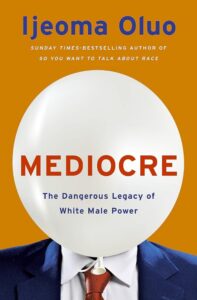
 Mediocre: The Dangerous Legacy of White Male Power by Ijeoma Oluo, Basic Books, December 1st, 2020
For some reason, I don’t remember how I found out about this book but when I heard about it, I immediately checked if the library had it and they did. They had eight copies but as I write, I am the only one with a copy on loan. I began and quickly finished it a few weeks ago, thinking it would give me a good chuckle. From time to time it did, but I was mostly baffled when not bored at the contents.
With a title like this, some might claim I’m just going for the low-hanging fruit of left-wing discourse and not seriously engaging with issues like racism and sexism. Yet this has been praised and endorsed by all the right sort of people including two writers in The New York Times and one bestselling author, the Washington Post, TIME Magazine, some professor from UCLA and some others I assume are political activists. On the back cover it is described as “deeply researched and revelatory” among other exaggerated praise. So this being the case, I am going to assume that the contents meet these high standards.
The problems begin with the title itself which is taken from a tweet by some woman named Sarah Hagi that reads, “Lord grant me the confidence of a mediocre white man.” though I couldn’t find the original. I had a quick look at her X account and she appears to be of mixed race and is also the kind of person that deliberately writes in all lower-case though software on most modern devices automatically corrects this. I don’t know anything else about her but she is mentioned in the book.
Leaving the tweet aside, the title doesn’t really work for what the author has written either as she doesn’t even know what “mediocre” means:
When I talk about mediocrity, I am not talking about something bland and harmless. I’m talking about a cultural complacency with systems that are horrifically oppressive. I’m talking about a dedication to ignorance and hatred that leaves people dead, for no other reason that the fact that white men have been conditioned to believe that ignorance and hatred are their birth rights and that the effort of enlightenment and connection is an injustice they shouldn’t have to face.
I wanted to quip here that the title describes the book but the book doesn’t even rise to the level of mediocrity. The above is taken from the introduction and when the author is not talking about herself, she is making assertion after assertion such as these two examples:
White men lead our ineffective government with almost guaranteed reelection [sic]. They lead our corrupt and violent criminal justice system with little risk of facing justice themselves. And they run our increasingly polarized and and misinforming media, winning awards for perpetrating the idea that things run best when white men are in charge. This is not a stroke of white male luck; this is how our white male supremacist systems have been designed to work.
…
This country’s [The United States] wealth was built on exploitation and violence, and those who worked hardest to build it were not empowered or enriched by its successes—they were enslaved people, migrant laborers, and domestic workers. Much of this country’s early infrastructure, for example, was built with slave labor, and then with grotesquely underpaid immigrant labor and prison labor. Many of our business and political leaders were freed to dedicate their time and energy to their professional success by the unpaid labor of wives and mothers and the underpaid labor of nannies and housekeepers.
None of this “revelatory” as described in the blurb but something that has been heard over and over for decades by anyone with a college education.
Ijeoma Oluo is the author’s actual birth name as far as I can tell and not one she made up to “reclaim” her black identity or anything silly like that. When I first saw the name (because I certainly can’t read it), I expected to find out she was born “Tiffany Johnson” or “Vanessa Washington” but this was not so. She is mixed race with a Nigerian father and an American mother of European descent but has consciously chosen the black half as her ethnicity of choice. Much like Barack Obama, she has no direct connection with American blacks and their history at all.
She begins the book mentioning a “women’s writing retreat” which she describes as:
…quite a change for someone like me: a single mom of two boys used to writing over the din of crashes and bangs and shouts and her own attention deficit disorder. I had adapted to being creative even with a teenage boy regularly interrupting to tell me that he needed more snacks and, yes, was still incapable of finding them himself.
I should apologise here as she does at least have some things beyond skin colour in common with black Americans such as single motherhood and undisciplined children who were abandoned by their father.
The first chapter is called “Cowboys and Patriots” which is an odd place to start if you’re going to cover the dangerous legacy of white mediocrity in the American context. Why not the early settlement, indentured servitude and the arrival of the first African slaves? I would have started here but Oluo starts with a supposedly real white guy she knows who she gives the pseudonym “Brian”. We’re told this Brian guy is annoying and watches Fox News and has different opinions to the author so he is bad even though from her own description, he just sounds earnest but possibly a little irritating. She then connects poor Brian with a mass shooter before beginning with the genesis of American white mediocrity… Buffalo Bill.
Buffalo Bill or William F. Cody was one of the men most responsible for popularising the “Wild West”: one of the most endearing and enduring aspects of American culture. The author uses him as a vehicle for discussing how beastly white men were to Indians, the buffalo, Chinese railroad workers and every other designated oppressed class available for mediocre whites to kick around at that time. Though in her own telling, she reveals that Cody, far from being a mediocrity, was a very successful showman who even had an influence on the early conservation movement among many other achievements. From her own account, it is clear he was a quintessential American but because his promotion of cowboy culture was adopted by “mediocre” men, he is bad. She segues Cody into the Bundy Ranch land dispute with the Federal government from a decade ago; an event I’d almost forgotten even happened. The Bundy’s were bad for defending their grazing rights. This is about it but the only example of white mediocrity is Brian and only if you believe everything she’s said about him. I have to say, that I think I’d get along with Brian alright though.
The next chapter titled, “For Your Benefit, In Our Image” interestingly covers white male feminists and social justice warriors. It also has the only good examples of “white male mediocrity” in the entire book. She opens by mentioning a comedian she found funny because he was a left-wing male feminist who made fun of people she doesn’t like. That was until he was unsurprisingly outed as a creep:
…in a sea of white male comedians making jokes in which women and people of color were the punchlines, this dude was making jokes in which those dudes were the punchlines.
…
It is probably less shocking to you than it was to me to find out that this comedian was actually bad. Very bad. First one woman came forward with a story of abuse, then another. Then more stories of sexual impropriety…
I could not find out exactly who this unnamed Seattle comedian was but searching around I found Louis C.K, Russel Brand, Chris D’Elia and Aziz Ansari as possibilities but I don’t think any of them match the description she gives. Whoever it is apparently became “alt-right” afterwards but that could now mean anything from joining a “neo-Nazi group” to the Cato Institute. She also claims that after this all came out, she realised he was always not very good but somehow still enjoyed him beforehand.
This anecdote leads into two early twentieth century male feminists:
Floyd Dell and Max Eastman were at the center of a new movement in the 1910s: socialist feminism. Born of an elite bohemian age, it melded the desire for female social and political power with the free-love experimentation of the art world and the socialist struggle against capitalist exploitation.
It will not be a surprise to learn that both of these men used the feminist movement for easy access to foolish women. Like we’re told with the unnamed comedian, both also later abandoned their young radicalism and she quotes disapprovingly from a wiser Dell:
“Do we want to train young people for . . . living happily ever after in heterosexual matehood, or for living tormented and frustrated lives of homosexuality, frigidity and purposeless promiscuity?”
Why indeed? All she shows here is the pattern of men joining women’s movements and groups to take advantage of them. And Dell obviously saw the brokenness in these radical movement that is still just as evident today.
She next complains about former fake president Joe Biden’s inconsistent stance on forced race-integration as a young senator in the 1970s. His constituents were hotly against it so he changed his stance to make sure he got re-elected. This is consistent with his entire political career as a shifty opportunist without any genuine principles but also a rare example of a politician doing what his voters want him to do.
Lastly, she covers the “Bernie Bros” of more recently history who were enthusiasts for Bernie Sanders who lost (with some controversy), to Hilary Clinton in the primary in 2016 and then ran but dropped out in 2020. Apparently these losers verbally abused people who supported Hilary Clinton online and focused too much on left-wing economic issues instead of race and gender as people like the author wanted. This makes them bad and even Bernie himself, by extension who is said to have “white male privilege”. This sounds like anti-Semitic dog-whistling. She then shares an implausible anecdote with a left-wing “Lyft” driver that she speaks truth to power to for daring to say that Obama had “focused too much on black people.” She concludes the chapter stating:
In an increasingly diverse country, white men can only demand to be the exclusive focus of our political systems for so long. Looking at how unfavourably some liberal white men view our small, occasional shifts in focus away from white maleness, I am afraid this will be a painful transition. But it doesn’t have to be. It is possible to have a different expectation for effective government besides one in which everyone in it looks like you and centers your needs above all else. I know this because my community has always had different expectations of government. Politics that does not always center white men is something that white men can get used to—and they must.
This is spoken largely to her fellow travellers but clearly applies to all “white men”. I expect I’m one of the very few hostile to her outlook that has actually read the book cover to cover. This establishes what is at the heart of people that think like her. Anyone who has grown up “white” in America, Australia, Britain, Canada, New Zealand or almost any other European nation, would be at pains to remember a time when “white men” were ever a factor in the governance of their countries. Yet, she thinks these same governments (and especially in the United States), still revolves around “white men”. It also shows (especially in this chapter), that there is no questioning her on this. If you don’t agree, you’re part of the problem. There can be no genuine dialogue.
The next chapter covers higher education which has been ruined now that more people attend and standards have been lowered for women and minorities. The only reason people still go through higher education is because the legal framework requires it for certain lucrative occupations like law and medicine. A college education was objectively more valuable when it was mostly restricted to the intellectual elite. She obviously doesn’t agree with any of this.
Chapter 4 gave me my first laugh in the opening sentences:
Even the most virulent American racist has to wrestle with the fact that the United States would not exist were it not for people of color.
The chapter recycles a lot of typical post-Civil War black oppression narratives. The author complains about her own experiences such as hearing people lock their cars in car parks as she walks by. She is narcissistic enough to believe it is because of her and not something people do after getting out of a parked car in a carpark.
The next chapter uses the 1980s Dolly Parton film 9 to 5 as a plausive example of how well corporate governance would work if women were in charge. She is, as best I can tell, quite serious about this. She later asserts:
…women have always shown their intellectual and leadership skills. Since before the time of the pharaohs, women have been fierce leaders, savvy politicians, and skilled teachers. Women have created masterpieces since the first cave dwellers were drawing on walls. Women have invented some of our most important devices, have led some of our most important scientific advancements, have written classic novels. They have healed the sick and philosophized about the world’s biggest questions.
Many of these assertions are true but the most important work women have always done is give birth to and raise children. Most women do this and it is more critical to the human race than any of these examples; including her more ludicrous examples above. As she shared at the very beginning, she doesn’t seem much interested in motherhood. Apart from an old Dolly Parton film, she covers labour history a little and complains about women and “people of color” being side-lined during the Great Depression. Then women being pushed out of manufacturing jobs at the end of the Second World War because the mediocre white men, that managed to survive and remained able-bodied, would unreasonably want jobs when they returned home.
The only interesting information in this chapter was her sharing this anecdote:
Women’s magazines like True Story published lurid tales of working women whose selfish ways led them down disastrous paths of sexual promiscuity, divorce, and infertility.
True Story was an apt title given this is exactly what has followed from large numbers of women being brought into the workforce and this has absolutely been socially destructive. Magazines like this briefly changed their messaging to help the war effort at the direction of the government but this 1930s “propaganda” certainly wasn’t wrong.
The remaining chapters deal mostly with more recent history including the success of politicians like Ilhan Omar and Alexandria Ocasio-Cortez who got elected because of a demographic shift in their electorates — often imposed from above. The last is about Colin Kaepernick and other athletes kneeling during the national anthem to protest things like police shooting violent criminals. Within she repeats misleading or flat out wrong claims about a number of famous incidents including Trayvon Martin and Michael Brown who were both good boys that didn’t do nothing. Once again, very little that hasn’t been read or heard by people who follow American social politics.
This book is under three hundred pages, with large, widely-spaced text and reads like seven stitched together long-form journalistic articles peppered with personal anecdotes. Most of the chapters aren’t even really about “mediocre white men” and do nothing to support her thesis; if I can even call it that. And the only chapter that does is the one about her own political allies. The chuds come away largely unmentioned and unscathed throughout. In her acknowledgements she thanks two research assistants she had to help her write it. The endnotes nearly all contain links to mainstream new websites though there are a few academic sources too. It is on the whole, quite a superficial read. A book like White Trash which I reviewed back in 2019, is somewhat in this anti-White subgenre of socio-political history but far more sophisticated. Mediocre is laughable in contrast and yet much like N.K. Jemisin’s awful fiction, Oluo’s resentful nonsense gets promoted as if she is a genuinely intelligent and original thinker.
It can be amusing to make fun of books and people like this but they are taken seriously and used to make government policy. Their books are taught or made recommended reading in universities and bought by public libraries as far away as Australia. Most corporations, sporting codes and social institutions incorporate the social narrative presented in books like this in their own policies — however awkward they fit. Yet, this book (and I’m sure many like it), is nothing but a shallow polemic by a deeply resentful and not very intelligent woman.